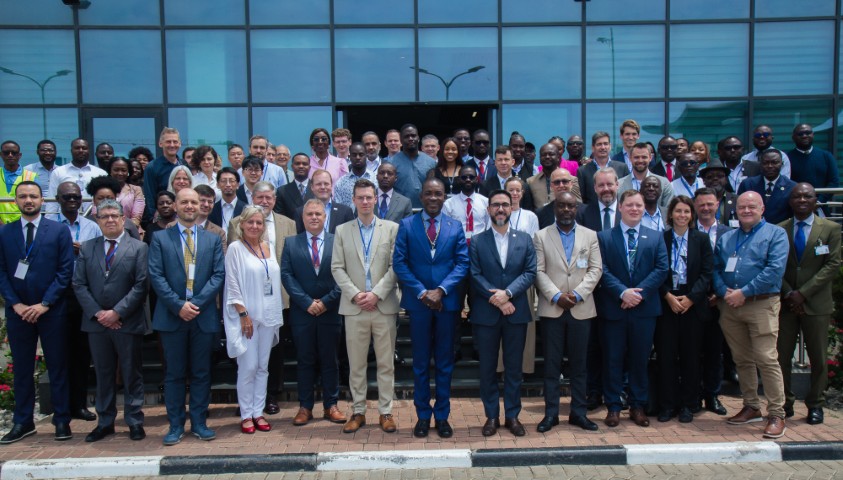
The Ghana Civil Aviation Authority (GCAA) has hosted the Joint Authorities for Rulemaking on Unmanned Systems (JARUS) Plenary Meeting, bringing together aviation regulators, industry stakeholders, observers and other experts to deliberate on the development of regulatory frameworks for unmanned aviation.
The meeting, which opened on Monday, 14 September 2026, at the GCAA Headquarters, Accra International Airport (AIA), focused on emerging issues surrounding remotely piloted aircraft systems (RPAS) and the need for effective, harmonised regulatory approaches to support their safe integration into the aviation ecosystem.
Addressing the opening ceremony, the Director-General of the GCAA, Rev. Stephen Wilfred Arthur, said the rapid growth of unmanned aviation presented both opportunities and challenges for regulators.
He said the GCAA had adopted a risk-based approach to RPAS regulation, including the adaptation of the JARUS Specific Operations Risk Assessment methodology through its Assessment of Risk for RPAS Operators (ARRO) framework.
According to him, the Authority was also strengthening its Performance- and Risk-Based Surveillance system to ensure that regulatory oversight remained effective and proportionate as RPAS operations increased in scale and complexity.
Rev. Arthur said the GCAA was taking steps to prepare for future developments in unmanned aviation, including the development of a national Unmanned Aircraft System Traffic Management (UTM) Concept of Operations and monitoring developments in Advanced Air Mobility (AAM).

He further noted that the Authority was pursuing digital solutions to improve the efficiency, transparency and accessibility of regulatory processes, including drone registration and renewal and importation clearance.
The Director-General also highlighted the practical applications of unmanned aircraft technology in Ghana, citing the use of RPAS by Zipline in medical logistics as an example of how unmanned systems could support the delivery of essential services.
He said similar applications could be expanded across sectors such as agriculture, environmental monitoring, mining, surveying, mapping and infrastructure inspection.
Rev. Arthur, however, stressed that the expansion of the unmanned aviation industry would require regulatory frameworks to evolve alongside technological developments.
He identified harmonised standards, regulatory cooperation and the exchange of regulatory experience as important to achieving safe, scalable and interoperable RPAS operations across jurisdictions.
He also called for greater collaboration in areas including capacity building, training and type certification, particularly to support emerging regulatory jurisdictions. He added that wider access to the international standards ecosystem could assist countries in effectively implementing JARUS guidance.
The JARUS Plenary provides a platform for participating authorities and other stakeholders to exchange experiences, consider emerging regulatory challenges and contribute to the development of common approaches to unmanned systems regulation.
Rev. Arthur encouraged participants to use the meeting to share experiences and identify practical solutions capable of strengthening the global regulatory framework for unmanned systems.
He said the future of unmanned aviation would depend on maintaining an appropriate balance between safety, innovation and accessibility.
The 5-day meeting brought together JARUS members and observers, alongside GCAA management and staff and other invited stakeholders, for discussions aimed at supporting the continued development of regulatory approaches for unmanned aviation.

You may also like
-
President Mahama: New ATC Tower, Other AIA Projects Funded by GCAA, GACL Without Government Funding
-
GCAA Holds 2026 Emergency Response Table-Top Exercise
-
GCAA, AFCAC and CAAS Empower African Aviation Professionals with Crisis Management Skills
-
GCAA Receives Final Sustainable Aviation Fuel Business Implementation Study Report
-
GCAA Hosts ICAO’s Instrument Flight Procedure Design Instructors Training Programme at GATA