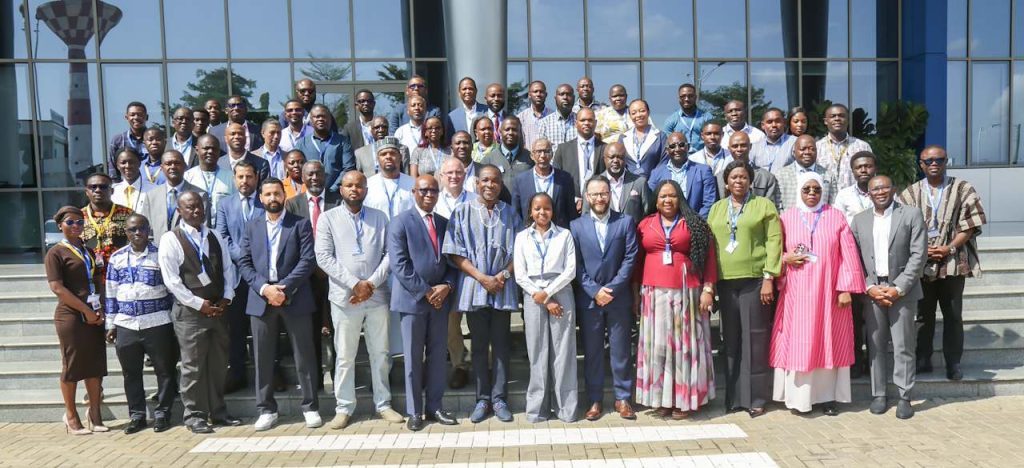
The International Air Transport Association (IATA) and Boeing have jointly organised a three-day runway safety workshop for aviation professionals at the Air Navigation Services Complex of the Ghana Civil Aviation Authority (GCAA) in Accra.
Opening the workshop on Wednesday, November 4, 2026, the Director-General of the GCAA, Rev. Stephen Wilfred Arthur, said bringing together airlines, an aircraft manufacturer, air navigation service providers, aerodrome operators, regulators and key industry organisations in one room to deliberate on the subject demonstrated the collective commitment required to improve runway safety.
“Having all these stakeholders in one room is a powerful statement that demonstrates that runway safety cannot be achieved in silos,” he said.
Rev. Arthur underscored the fundamental role of runways in the aviation ecosystem, describing them as critical components of airport infrastructure.
“If a runway is not functional, if there are issues with a runway, an airport will be another white elephant,” he stated.
He observed that the importance of runways was sometimes overshadowed by the attractions and ambience of airport terminals, stressing that their significance in the overall aviation architecture could not be relegated to the background.

Rev. Arthur said meaningful progress in runway safety would require robust collaboration, open dialogue and a unified regional strategy.
According to him, the workshop represented a shared commitment to safeguarding one of the most critical phases of flight operations, as every flight begins and ends on a runway, where flight crews, air traffic controllers, aerodrome operators and infrastructure converge.
He stressed the need to secure runway movements and operations, noting that runway excursions and incursions remained high-risk categories under the International Civil Aviation Organization’s (ICAO) Global Aviation Safety Plan.
He added that tail strikes, although rarely fatal, were costly and often indicative of deeper challenges relating to approach stability, aircraft performance calculations and training.
Rev. Arthur said safety performance in the Africa-Indian Ocean (AFI) Region had improved significantly through initiatives such as the Abuja Safety Targets and support from ICAO and industry partners.
However, he noted that runway-related occurrences continued to account for a significant proportion of accidents and serious incidents in the region.
He also highlighted persistent operational challenges in some countries, including the presence of animals on runways, sometimes crossing freely during take-off clearances.
The GCAA Director-General observed that the opening day of the workshop coincided with the fifth anniversary of the implementation of ICAO’s Global Reporting Format (GRF) for runway surface conditions, describing it as an opportune moment to assess how effectively the framework had been adopted across the region.
He expressed optimism about ongoing airport resurfacing works being undertaken by the Ghana Airports Company Limited (GACL), saying the projects were important for improving safety and operational efficiency.

Rev. Arthur said Ghana continued to strengthen its State Safety Programme, guided by the National Aviation Safety Plan.
As part of the country’s runway safety initiatives, he noted that local Runway Safety Teams had been established at the Accra International Airport and the regional airports, alongside the full implementation of the GRF.
He further pointed to the Global Action Plan for the Prevention of Runway Excursions and Runway Incursions as a clear roadmap for stakeholders, stressing, however, that plans alone could not prevent incidents without active implementation.
“Plans on paper do not by themselves stop aircraft or vehicles, but active implementation does,” he said.
The workshop agenda included reviews of global safety standards, accident trends and Africa’s regional safety overview, as well as discussions on runway incursions and presentations from IATA and the ICAO Western and Central African (WACAF) Office.
Rev. Arthur urged participants to use the insights gained to address operational bottlenecks and other challenges affecting runway safety.
He said the workshop had an ambitious objective: to agree on key strategic priorities for runway safety in the region and identify or revitalise initiatives capable of delivering tangible, high-impact improvements.
He encouraged participants to engage in candid discussions and embrace a just culture of open and honest exchanges while examining operational experiences and case studies.
“Hiding these challenges is not the way to go. This platform is not for shaming, but for being very honest about where we are, calling for help and promoting collaborative action,” he said.
He also urged participants to focus on critical priorities and commit to actionable roadmaps with clear timelines, ownership and measurable performance indicators.
Emphasising that runway safety was a shared responsibility, Rev. Arthur expressed appreciation to IATA and Boeing for their continued commitment to safeguarding the travelling public.

Boeing Reaffirms Commitment to Regional Safety Collaboration
In a brief address, Boeing’s Director of Global Safety and Regulatory Affairs for the Middle East and Africa, Mr Kay Ariwodola, said the workshop was particularly important to the aircraft manufacturer, which remained committed to supporting initiatives aimed at improving aviation safety.
He said Boeing intended to sustain similar engagements across Africa, citing significant opportunities to enhance safety performance among airlines and civil aviation authorities.
Mr Ariwodola noted that, beyond its collaboration with IATA, Boeing maintained partnerships with the African Civil Aviation Commission (AFCAC), ICAO’s Eastern and Southern African (ESAF) and Western and Central African (WACAF) regional offices, as well as Regional Safety Oversight Organisations such as the Banjul Accord Group Aviation Safety Oversight Organisation (BAGASOO), the Civil Aviation Safety and Security Oversight Agency (CASSOA) and the Southern African Aviation Safety Oversight Organisation (SASOO), among others.
He said Boeing’s approach was to establish meaningful partnerships and develop activities organically based on the needs of regional stakeholders.
The company, he stressed, was not interested in short-lived engagements but rather in understanding safety gaps across the region and providing support based on its experience and feedback from partners.
Runway Safety Trends and Accident Statistics
Two IATA representatives, Mr Edickson Santamaria, Safety Senior Manager for Europe, and Ms Rachael K. Nyaga, Senior Manager, Safety, presented global and regional accident trends to provide participants with a broader perspective on runway safety.
The presentation by Mr Santamaria highlighted improvements in global aviation safety over the past decade. Whereas the industry recorded one fatal accident for every 3.5 million flights a decade ago, the rate improved to one fatal accident for every 4.8 million flights in 2025.
Despite the progress, he noted that significant work remained, with 394 onboard fatalities recorded in 2025.
He also observed that the number of accidents declined in 2021 but had begun increasing again as air traffic returned to pre-COVID-19 levels.

In 2025, Mr Santamaria said the global aviation industry operated 38.7 million flights, recording 49 accidents, eight of which were fatal.
Runway-related occurrences featured prominently among the top 10 causes of accidents, including runway excursions, runway incursions, tail strikes and hard landings.
According to his presentation, over the past decade, 48 per cent of global accidents, representing 233 occurrences, were runway safety-related. Of these, runway excursions accounted for 20 per cent, tail strikes 14 per cent, hard landings nine per cent and runway damage five per cent.
For the first half of 2026, from January to June, Mr Santamaria said the industry recorded 24 accidents, three of which were fatal. The occurrences included five tail strikes, five hard landings, four runway excursions and two cases of runway damage.
In the ranking of runway-related occurrences, runway incursions involving collisions led, followed by runway excursions, tail strikes and hard landings in that order.
Africa’s Runway Safety Performance
In Africa, seven runway safety-related accidents were recorded in 2025, resulting in two fatalities across 890,000 flights, according to Ms Nyaga.
She said over the past decade, runway excursions accounted for 21 per cent of Africa’s runway safety-related accidents, while runway damage represented 12.5 per cent, hard landings 4.5 per cent and tail strikes 1.5 per cent.
For the first half of 2026, the African region, she noted, recorded three runway safety-related accidents, none of which was fatal. These comprised two runway excursions and one hard landing.
The workshop brought together representatives from airlines, the GCAA, GACL, airport operators, safety managers, pilots, air traffic controllers and other international and regional aviation stakeholders.

You may also like
-
GCAA, ICAO Conclude Five-Day Workshop to Strengthen Aeronautical Information Management in Ghana
-
GHATCA Joins Global Community to Mark 65th Anniversary of Air Traffic Controllers Day
-
IIA Ghana Pays Courtesy Call on GCAA Director-General to Mark 25th Anniversary
-
GCAA Hosts JARUS Plenary Meeting on Unmanned Systems
-
President Mahama: New ATC Tower, Other AIA Projects Funded by GCAA, GACL Without Government Funding